Jacob Rose
Straight ManJacob Rose is a longtime friend of William Henry Devereaux, Jr. and a dean whose relaxed, sometimes self-deprecating manner sits alongside a talent for navigating university politics. He is not merely a confidant observing the institution’s conflicts: he helps shape them, keeping consequential information close, making appointments and personnel decisions, and ultimately rising into a position of greater authority. His friendship with William Henry Devereaux, Jr. gives the book one of its most revealing contrasts between private loyalty and public power.
Identity and Background
Jacob and William Henry Devereaux, Jr. arrived at the university in 1971, and their long acquaintance gives Jacob unusual insight into his friend’s habits and character. Their exchanges assume an intimacy built over decades: Jacob can imitate William Henry Devereaux, Jr., while also recalling how colleagues regarded him when they first arrived. Familiarity does not make their friendship sentimental. Jacob’s humor often takes the form of teasing, and their conversations make room for frank criticism as well as practical support.
Jacob is dean when the English Department is trying to find a new chair. He had previously been a member of the department, and he retains ties to it after moving into Liberal Arts. His former English secretary, Marjory Brownlow, followed him to the dean’s office and declined several administrative positions, a choice William Henry Devereaux, Jr. attributes either to loyalty to Jacob or to contempt for the administration under Dickie Pope. Her connection to both men makes her a quiet link between departmental life and the dean’s office.
The book’s portrait of Jacob is filtered through William Henry Devereaux, Jr., who regards him as a decent friend but not an especially distinguished academic. That judgment is qualified by the plot: Jacob’s market prospects surprise them both, and the apparent ease of his manner can obscure how much he knows or how carefully he is managing a situation. William Henry Devereaux, Jr. also recognizes that Jacob enjoys storytelling and may embellish events. The friendship therefore offers intimacy without making Jacob’s account, or William Henry Devereaux, Jr.’s interpretation of him, automatically complete.
The Department and the Dean’s Office
Jacob is drawn into the dispute over the search for a new English Department chair. The search begins with permission to proceed, but the university delays funding, restricts interviews, invokes a hiring freeze, and eventually leaves only three candidates from an original pool of two hundred. Finny suspects Jacob is pushing the search and suspects William Henry Devereaux, Jr. of helping undermine it. William Henry Devereaux, Jr. reports instead that Jacob is more pushed against than pushing. The stalled process becomes a measure of the department’s divisions and of how easily the dean’s friendship with William Henry Devereaux, Jr. can be read as political collusion.
Jacob’s influence is not limited to the chair search. He tells William Henry Devereaux, Jr. that the English Department’s review has been moved forward: an internal review will begin in September, followed by an external review in October. The acceleration is presented as a money decision, with several university units reviewed together so the main campus can promote the idea that they constitute one geographically dispersed university. For William Henry Devereaux, Jr., the timing is disruptive because the department is already in transition and looking for a new chair.
Their friendship also creates expectations about access to information. Finny believes William Henry Devereaux, Jr. ought to know whether the dean is pressing the chair search because he and Jacob are friends. William Henry Devereaux, Jr. has no concrete information to provide, but his lack of inside knowledge does not quiet suspicion. Later, he recalls Marjory asking whether she might return to the English Department if Rachel Williams left. Marjory asked him not to tell Jacob; he promised, then forgot the conversation until seeing her again. The episode shows how secrets, loyalty, and forgetfulness circulate between the departments and the dean’s office, without establishing what Marjory herself knew about the university’s later decisions.
Friendship, Candor, and Concealment
Jacob and William Henry Devereaux, Jr. share a combative comic style that allows them to criticize one another without ending the friendship. At a downtown lunch at Keglers, Jacob has already begun his corned-beef sandwich because he has another appointment and must eat quickly. Their ordinary conversation takes place against the town’s decline, but Jacob’s immediate concern is work: he tells William Henry Devereaux, Jr. that the department review is coming sooner than expected. The meal makes a useful counterpoint to their administrative entanglements; the two friends meet in an unceremonious setting even as university policy presses in on them.
Jacob also witnesses William Henry Devereaux, Jr.’s unpredictable conduct from the position of a friend who may be affected by it. After William Henry Devereaux, Jr. threatens on television to kill a duck each day until the department receives a budget, he wishes that Jacob were present to hear about the stunt, while knowing Jacob would disapprove. The action places Jacob among the people whose judgment William Henry Devereaux, Jr. seeks even when he has deliberately defied their instructions. Jacob had left him temporarily in charge and told him to do nothing; William Henry Devereaux, Jr. understands that his public threat violates both the instruction and the spirit of their working relationship.
Their ease does not prevent mutual misreading. When William Henry Devereaux, Jr. reaches Jacob’s office after Jacob returns from California, he greets him with an insult, and Jacob recognizes the greeting as a successful imitation of William Henry Devereaux, Jr. The exchange is playful, but Jacob’s own situation has been hidden: he tells his friend that he has received a job offer, then reveals that Dickie Pope dismissed him in October. Jacob had kept the firing secret, a decision that surprises William Henry Devereaux, Jr. His spirits are high because he can disclose the loss and the unexpected opportunity together, turning concealed adversity into a moment of triumph.
The news sharpens the friendship’s emotional stakes. William Henry Devereaux, Jr. admits that Jacob’s departure would matter to him and feels envy at the thought that his friend has managed to climb out of the difficulties they share. Jacob then asks him to serve as best man at his wedding. The request makes clear that Jacob regards William Henry Devereaux, Jr. as more than a useful colleague, even as career changes begin to pull them in different directions.
Power, Personnel, and Decisions
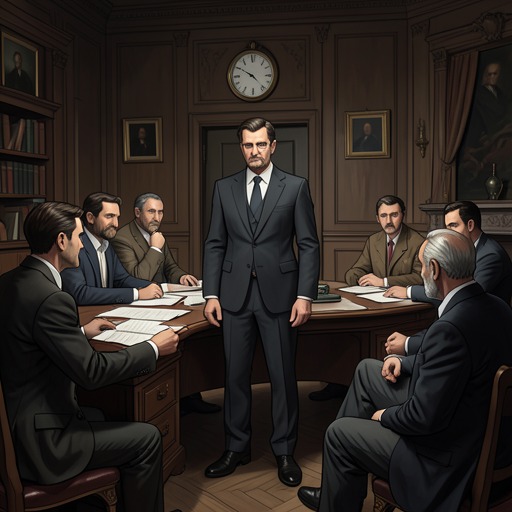
Jacob’s rise brings him into direct contact with decisions that affect William Henry Devereaux, Jr.’s colleagues. When the department initiates proceedings against its chair, Jacob attends because the dean or a representative must be present and because he is technically still a member of the English Department. William Henry Devereaux, Jr. secretly listens from above the conference table, where he can see only parts of the meeting. Jacob observes that the faculty seem to have become absorbed in imagining where William Henry Devereaux, Jr. might be hiding. His dry remark punctures the department’s tense efforts to locate its missing chair without resolving the proceedings themselves.
Later, Jacob describes what will happen to several people as the university’s personnel decisions take shape. Orshee will have a year to find another position; Finny will receive a year’s sabbatical at half pay to finish his dissertation at Penn, with the possibility of later teaching composition as an adjunct; and Billy Quigley’s reassignment will be seen as an act of kindness. Jacob’s brisk assessments show him speaking from inside the machinery of decision-making. The contrast between the practical terms he offers and the personal consequences for his colleagues makes his new authority tangible.
William Henry Devereaux, Jr. eventually understands that Jacob is replacing Dickie Pope at the university’s upper administrative level. Jacob proposes that William Henry Devereaux, Jr. become dean, but the offer comes with costs: Marjory is to retire, Jacob needs a secretary, and he plans to take Rachel Williams from William Henry Devereaux, Jr.’s office. He also proposes that the department elect Paul Rourke chair, after which the two friends could take turns mistreating him. The suggestion is both a concrete plan for staffing and a characteristically irreverent vision of power as an opportunity for mischief.
William Henry Devereaux, Jr. declines the deanship. He sees that Jacob’s appointment of a friend would be interpreted as favoritism and could damage Jacob politically, even though he admits that imagining the two of them in power briefly tempts him. Jacob reacts with frustration, reading the refusal as another instance of his friend preferring to disrupt institutions from the margins. The exchange does not end their friendship, but it exposes a real difference: Jacob accepts the need to operate within the university’s hierarchy, while William Henry Devereaux, Jr. refuses the promotion and its obligations.
Later Work and Continuing Ties
Jacob’s administrative reach also revives a project that had been left dormant. Without first asking William Henry Devereaux, Jr. and Lily, he retrieves a grant proposal they wrote nearly a decade earlier and presents it to the chancellor. The plan would track academically promising, disadvantaged high-school students in and around Railton from their sophomore year and guarantee tuition and books at the Railton Campus while they maintained their grades. With Lily promoted to principal at Railton High School, the proposal appears newly practicable. Jacob’s intervention gives the old plan another chance, though Paul Rourke hears of it and calls it a Devereaux boondoggle without appearing interested in stopping it.
Jacob remains connected to William Henry Devereaux, Jr. beyond the university’s internal contests. After Tony Coniglia is hospitalized overnight for heart fibrillations, Jacob suggests visiting him with a group of friends. William Henry Devereaux, Jr. brings Russell, partly thinking Russell might help with Tony’s computer. By the time they arrive, the house is full of men and Jacob is acting as host, greeting the visitors with whiskey and a joke about the pizza. His teasing welcome quickly becomes an introduction to Russell, whom he likes after Russell offers to fetch the food.
These later scenes do not erase Jacob’s role in conflict or his capacity to keep important news from his friends. They place those qualities alongside practical initiative, social warmth, and a continuing investment in people around him. He can revive a neglected educational proposal, arrange a visit for an ill friend, and make an ambitious personnel offer; he can also conceal his dismissal and move decisively into a new position. The result is a portrait of a friend whose influence grows even as William Henry Devereaux, Jr. chooses not to follow him into power.